
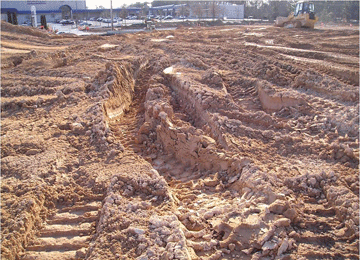
Winter grading basics for wet job sites
Most winter grading problems are water problems in disguise. Cold temperatures get the blame, but it’s saturation (not frost) that triggers rutting, subgrade pumping, and the costly rework that pushes schedules into spring. Winter grading can absolutely continue, but wet soil, increased traffic, and compromised drainage raise the stakes on every decision made on site.
Keep Water Moving Off the Site
Positive drainage is the first line of defense for moisture management. Active work areas should be sloped so runoff clears quickly rather than pooling against compacted lifts. Cut and maintain swales, berms, and temporary diversions daily, not weekly. A single low spot that holds water overnight can undermine a full day of compaction work. Channel runoff away from the building pad and subgrade before it has a chance to infiltrate.
Protect the Building Pad and Subgrade Early
During summer, grading a building pad flat to subgrade elevation is standard practice. In winter, it invites trouble. Grading the pad high and crowned protects the slab subgrade from direct equipment contact; when it’s time to pour, the excess material is cut to final elevation with little or no undercut required.
Where grading to subgrade is necessary, placing a compacted crusher run base helps shed water, unlike open-graded washed stone, which holds it. For sites with persistent moisture issues, cement or lime stabilization can create a nearly weatherproof subgrade and allow work to continue through difficult conditions.
Repair Ruts and Soft Spots Before They Spread
Depressions and wheel ruts aren’t cosmetic issues, they’re water-collection points. When equipment tracks cut channels into an active work area, those channels become erosion pathways during the next rain event. A localized soft spot ignored until end-of-shift can expand into a zone requiring removal and replacement. The cost of a grader pass to smooth and crown a haul route is negligible compared to the cost of remobilizing equipment after a subgrade failure. Repair early, repair often.
Control Equipment Traffic on Wet Soils
Rubber-tired equipment concentrates loads into small contact patches, generating unit pressures that saturated fine-grained soils simply cannot support. Unlike tracked equipment, which distributes loads over a larger footprint, wheeled vehicles punch through weakened layers and knead underlying soils into slurry. A loaded dump truck crossing a marginal surface can create ruts six to twelve inches deep in a single pass. Designate tracked-only zones on sensitive areas, keep heavy wheeled equipment on established routes, and restrict random access across the site. When wheeled traffic is unavoidable, use working platforms, don’t improvise.
Build and Maintain Winter Access Routes
Designated haul routes are not optional on a wet winter site, they’re the mechanism that keeps everything else working. Construct running surfaces using compacted crusher run; where subgrade conditions are poor, a geotextile separation layer beneath the base course prevents fine-grained soils from pumping up into the aggregate.
Once routes are established, maintain them. Potholes, rough areas, and wheel ruts should be filled regularly so that rain and snowmelt drain off rather than pool. Enforce access discipline: when crews know where they can and cannot drive, traffic stays on surfaces designed to handle it.
Winter grading is manageable, but success requires more planning than summer work. Drainage, subgrade protection, traffic control, and fast correction of soft spots have to work together. Let any one slip, and the others follow. Factor the additional time and cost into project schedules from the start, and the season becomes a constraint to work around rather than a crisis to recover from.