Dewatering and Water Transfer

Partnering with ECS water solutions for dewatering + water transfer projects

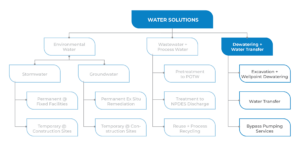
ECS water solutions partners with clients to design, manage and execute dewatering and water transfer projects. With expertise ranging from excavation and wellpoint dewatering to water transfers and bypass pumping services, we support clients with construction, underground utilities, pipelines, oil and gas industry, environmental remediation, habitat restoration and industrial maintenance projects.

Dewatering focuses on maintaining dry conditions within excavations or work areas by managing groundwater and surface water infiltration. Water transfer addresses the movement of large volumes of water from one location to another to support construction, drilling or maintenance activities. Bypass pumping provides temporary flow management when existing sewer, process water or drainage systems are taken offline.


LET’S TALK

ECS water solutions partners with clients to design, manage and execute dewatering and water transfer projects. With expertise ranging from excavation and wellpoint dewatering to water transfers and bypass pumping services, we support clients with construction, underground utilities, pipelines, oil and gas industry, environmental remediation, habitat restoration and industrial maintenance projects.

Dewatering focuses on maintaining dry conditions within excavations or work areas by managing groundwater and surface water infiltration. Water transfer addresses the movement of large volumes of water from one location to another to support construction, drilling or maintenance activities. Bypass pumping provides temporary flow management when existing sewer, process water or drainage systems are taken offline.


LET’S TALK

Dewatering and Water Transfer

How we engage

ECS water solutions delivers a single, unified team in place of separate consultants, technicians, equipment vendors and subcontractors.

Dewatering and Water Transfer

Services we can provide

  • Project Manager to monitor almost all scopes of dewatering, water transfer or bypass pumping
  • Owner’s representative to protect budget, schedule, quality, compliance and risk
  • Consultant for regulatory strategy, permitting and design
  • Service provider for pump operations and on‑site support
  • Equipment and consumables supplier
  • Contractor or subcontractor for field operations

What this means for your project

This model reduces coordination and handoffs, supports faster response times when conditions change and helps maintain smoother execution with lower overall costs during the life of the project.

Dewatering and Water Transfer

Project planning considerations

Planning dewatering and water transfer projects calls for early coordination to support efficient operations, maintain dry working conditions and manage potential impacts to structures, active work areas, environmental considerations and overall project schedules.

How we engage

ECS water solutions delivers a single, unified team in place of separate consultants, technicians, equipment vendors and subcontractors.

Dewatering and Water Transfer

Services we can provide

  • Project Manager to monitor almost all scopes of dewatering, water transfer or bypass pumping
  • Owner’s representative to protect budget, schedule, quality, compliance and risk
  • Consultant for regulatory strategy, permitting and design
  • Service provider for pump operations and on‑site support
  • Equipment and consumables supplier
  • Contractor or subcontractor for field operations

What this means for your project

This model reduces coordination and handoffs, supports faster response times when conditions change and helps maintain smoother execution with lower overall costs during the life of the project.

Dewatering and Water Transfer

Project planning considerations

Planning dewatering and water transfer projects calls for early coordination to support efficient operations, maintain dry working conditions and manage potential impacts to structures, active work areas, environmental considerations and overall project schedules.

Dewatering and Water Transfer

Dewatering project conditions + challenges

Dewatering and Water Transfer

Dewatering project conditions + challenges

Each dewatering project presents site-specific challenges shaped by soil conditions, groundwater levels, seasonal weather patterns and environmental regulations. Uncontrolled water can destabilize excavations, disrupt path schedules, affect working conditions and increase exposure to claims or regulatory violations. Whether projects involve high-permeability sands, low-permeability clays, tidal influence, or contaminated groundwater, ECS water solutions evaluates these variables and develops tailored dewatering strategies supported by bypass pumping where project conditions require temporary flow management. Experience across construction, pipelines, oil and gas, and environmental remediation allows ECS to anticipate challenges early and support reliable water management solutions even under demanding project conditions.

Each dewatering project presents site-specific challenges shaped by soil conditions, groundwater levels, seasonal weather patterns and environmental regulations. Uncontrolled water can destabilize excavations, disrupt path schedules, affect working conditions and increase exposure to claims or regulatory violations. Whether projects involve high-permeability sands, low-permeability clays, tidal influence, or contaminated groundwater, ECS water solutions evaluates these variables and develops tailored dewatering strategies supported by bypass pumping where project conditions require temporary flow management. Experience across construction, pipelines, oil and gas, and environmental remediation allows ECS to anticipate challenges early and support reliable water management solutions even under demanding project conditions.

Our approach to dewatering projects

  • Conduct detailed site assessment: Analyze soil permeability, groundwater levels, flow rates and potential contamination through hydrogeological data and pumping tests to select the appropriate methods such as wellpoint systems, deep wells or sump dewatering.  
  • Evaluate excavation parameters: Consider depth, size, duration and required drawdown, as shallow trenches often suit wellpoint or sump methods while deeper excavations may need deep wells or multi-stage systems.
  • Match method to soil type: Select approaches based on permeability—wellpoints or sump pumping for high-permeability sands/gravels; educator or specialized systems for low-permeability clays and silts.
  • Evaluate required pumping capacity: Calculate expected flow volumes and whether continuous or intermittent operation is needed to maintain stable, dry working conditions without over- or under-pumping.
  • Incorporate discharge and treatment needs: Factor in discharge location (surface water, storm sewer or land application), water quality and required filtration or sedimentation to meet regulatory limits.
  • Assess regulatory and environmental constraints: Identify early permit requirements, environmental sensitivities and impacts to adjacent structures or groundwater resources.
  • Balance cost, schedule and risk: Choose the most efficient, least invasive option that reduces mobilization time, equipment needs and potential delays while providing reliable performance and contingency planning.

Our approach to dewatering projects

  • Conduct detailed site assessment: Analyze soil permeability, groundwater levels, flow rates and potential contamination through hydrogeological data and pumping tests to select the appropriate methods such as wellpoint systems, deep wells or sump dewatering.  
  • Evaluate excavation parameters: Consider depth, size, duration and required drawdown, as shallow trenches often suit wellpoint or sump methods while deeper excavations may need deep wells or multi-stage systems.
  • Match method to soil type: Select approaches based on permeability—wellpoints or sump pumping for high-permeability sands/gravels; educator or specialized systems for low-permeability clays and silts.
  • Evaluate required pumping capacity: Calculate expected flow volumes and whether continuous or intermittent operation is needed to maintain stable, dry working conditions without over- or under-pumping.
  • Incorporate discharge and treatment needs: Factor in discharge location (surface water, storm sewer or land application), water quality and required filtration or sedimentation to meet regulatory limits.
  • Assess regulatory and environmental constraints: Identify early permit requirements, environmental sensitivities and impacts to adjacent structures or groundwater resources.
  • Balance cost, schedule and risk: Choose the most efficient, least invasive option that reduces mobilization time, equipment needs and potential delays while providing reliable performance and contingency planning.

Our approach to water transfer + bypass pumping projects

Identify average and peak flow rates (including wet-weather events) through the sewer, utility, or waterway to size the bypass system accurately and reduce overflows or surcharging.

Analyze pipe depth, sewage level, static suction lift, discharge distance and total dynamic head to select appropriate self-priming centrifugal, submersible or dry-prime pumps.

Choose solids-handling pumps with non-clog impellers capable of passing large debris for wastewater, while considering pH, contaminants, or clean water for utility/waterway transfers.

Design with N+1 backup pumps and automated system functionality to support continuous 24/7 operation and maintain stable system performance.

Select proper piping materials, sizes and installation methods, along with compatible sewer plugs or isolation devices, while optimizing staging areas and velocity limits.

Factor in discharge permits, downstream impacts, noise attenuation, odor control and spill prevention to meet NPDES, local utility and waterway requirements.

Consider short- vs. long-term needs, power sources (diesel/electric), maintenance access, and contingency plans to deliver an efficient bypass that reduces downtime and liabilities.

Project factors + regulations we navigate

  • Section 404 Permits
  • 303(d) impaired waters
  • Low-threat or limited-threat discharge permits
  • High-capacity well approvals
  • In-water work periods
  • Federal NPDES
  • Discharge permits to municipal Publicly Owned Treatment Works (POTW)
  • Work near endangered species or sensitive habitats
  • High profile projects with public scrutiny that shapes project strategy and communication


Regulatory + stakeholder coordination

Backed by regulatory knowledge and relationship‑driven engagement, ECS water solutions negotiates permits, provides agency education, develops contingency plans for sensitive or high‑profile sites and serves as a trusted liaison among clients, regulators, environmental groups and stakeholders.


Sectors we support:

Clients across construction, heavy civil, underground utilities, pipelines, oil and gas, environmental remediation, habitat restoration and industrial maintenance sectors rely on ECS water solutions for dewatering and water transfer projects.

 

Project factors + regulations we navigate

  • Section 404 Permits
  • 303(d) impaired waters
  • Low-threat or limited-threat discharge permits
  • High-capacity well approvals
  • In-water work periods
  • Federal NPDES
  • Discharge permits to municipal Publicly Owned Treatment Works (POTW)
  • Work near endangered species or sensitive habitats
  • High profile projects with public scrutiny that shapes project strategy and communication


Regulatory + stakeholder coordination

Backed by regulatory knowledge and relationship‑driven engagement, ECS water solutions negotiates permits, provides agency education, develops contingency plans for sensitive or high‑profile sites and serves as a trusted liaison among clients, regulators, environmental groups and stakeholders.


Sectors we support:

Clients across construction, heavy civil, underground utilities, pipelines, oil and gas, environmental remediation, habitat restoration and industrial maintenance sectors rely on ECS water solutions for dewatering and water transfer projects.

 

Dewatering and Water Transfer

Ready to discuss your project?

Our water solutions team can review site conditions, regulatory considerations and treatment pathways so you can plan the next phase of work with clarity. Contact us to start the conversation.

START YOUR PROJECT

Our water solutions team can review site conditions, regulatory considerations and treatment pathways so you can plan the next phase of work with clarity. Contact us to start the conversation.

START YOUR PROJECT