
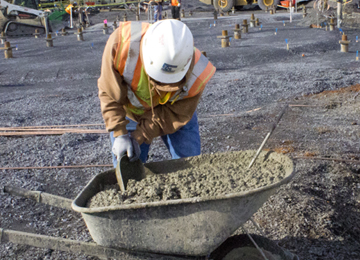
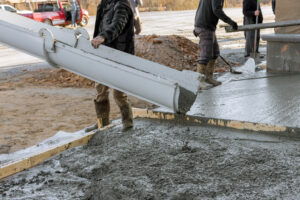
Last updated 5/15/2026 – When temperatures drop below freezing for multi-day stretches, the rules for concrete placement change. Two risks dominate: slow strength gain and early freezing damage.
Cement hydration (the chemical process that builds concrete strength) slows significantly as temperatures fall and if fresh concrete freezes before it develops adequate strength, ice crystals disrupt the paste structure and compromise long-term durability.
Planning protection strategies before a cold snap arrives is the difference between a smooth pour and costly rework.
Temperature at Placement
ACI 306R defines cold weather as any period when air temperature falls—or is expected to fall—below 40°F
| Section Size, Minimum Dimension | ||||
| Minimum Concrete | <12 inches | 12-36 inches | 36-72 inches | >72 inches |
| Temperature as Placed and Maintained |
55°F | 50°F | 45°F | 40°F |
Surfaces receiving concrete must be above 32°F to prevent freezing at the interface. Once placed, concrete must be maintained at the temperatures above and kept moist for at least 72 hours.
Insulated blankets, heated mats, or heated enclosures are common solutions. Confirm they’re on site before the pour begins. Field-cured cylinders must receive the same temperature and moisture treatment as the concrete they represent, particularly when used to verify strength for formwork removal or post-tensioning.
Mix design considerations
Cold-weather mix adjustments can meaningfully reduce risk:
- Higher cement content or Type III cement accelerates early strength gain and speeds formwork removal
- Lower water-to-cementitious ratios improve durability and reduce freeze-thaw susceptibility
- Non-chloride accelerating admixtures speed hydration — calcium chloride should be avoided where reinforcing steel is present, as chlorides promote corrosion
- Mineral admixtures (slag, fly ash) offer durability benefits but can retard initial strength gain in cold weather; an accelerating admixture may be needed to offset this
ACI also recommends air-entrained concrete to protect against freeze-thaw damage during the construction period.
When subgrades fail: Undercut or stabilize?
Cold weather affects more than the concrete — freeze-thaw cycles and prolonged wet conditions can compromise subgrade bearing capacity before a single yard is placed. When that happens, teams must choose between removing and replacing problem soils or stabilizing in place.
Undercutting is often the lower-risk path for localized, shallow issues. Excavate poor material, evaluate the newly exposed subgrade, then compact select fill in controlled lifts. Acceptance criteria are well-established, density testing is routine and schedule impact is predictable.
Lime treatment is effective for high-plasticity clays and silts — common soil types in Piedmont geology. Quicklime or hydrated lime reduces plasticity, improves workability and generates cementitious compounds that build long-term strength. Construction-grade lime is required; agricultural lime does not provide equivalent benefit.
Cement stabilization applies to a broader range of soil types, including silty sands and develop strength faster than lime — an advantage on tight schedules. Dosage, mixing depth and curing requirements must be established through lab testing. Soil lime/cement mix design services provide the analysis needed to hit target strengths reliably and avoid costly under- or over-design.
Key Takeaways
Successful winter concrete work requires proactive planning on two fronts: protecting fresh concrete from freezing and maintaining subgrade integrity before placement begins. When conditions deteriorate, choose the recovery method that fits your site — undercutting for speed and predictability, lime or cement stabilization for widespread moisture problems. Consistent testing and documentation across both fronts protect quality while reducing cost and schedule risk.
Questions about cold weather concrete or subgrade recovery on your next project? Contact the ECS materials testing team.