Nondestructive Evaluation

nondestructive evaluation

Evaluate materials and structures without damage

ECS Group of Companies (ECS) applies nondestructive evaluation (NDE) to verify integrity and detect flaws without cutting, coring or taking systems out of service. From structural steel to concrete, roofs and subsurface utilities, our technicians use proven methods to help you meet code, reduce risk and make informed decisions.

NDE is a toolset integrated across ECS’ disciplines. Whether your project involves new construction, maintenance or forensic evaluation, we select the right method for your goals and deliver actionable results that keep work moving.


CONTACT US
ECS Group of Companies (ECS) applies nondestructive evaluation (NDE) to verify integrity and detect flaws without cutting, coring or taking systems out of service. From structural steel to concrete, roofs and subsurface utilities, our technicians use proven methods to help you meet code, reduce risk and make informed decisions.

NDE is a toolset integrated across ECS’ disciplines. Whether your project involves new construction, maintenance or forensic evaluation, we select the right method for your goals and deliver actionable results that keep work moving.


CONTACT US
nondestructive evaluation

Why ECS for NDE Services?

Projects often require NDE to comply with building code and client specifications. Missing or incorrectly sequencing these steps can lead to rework, schedule impacts and liability. ECS solves this by integrating NDE with engineering, inspection and construction services—that means fewer vendors, faster coordination and recommendations backed by multidisciplinary expertise. Our certified level II technicians and certified welding inspectors (CWI) work alongside engineers to align the test plan with your schedule and compliance needs.


Construction materials

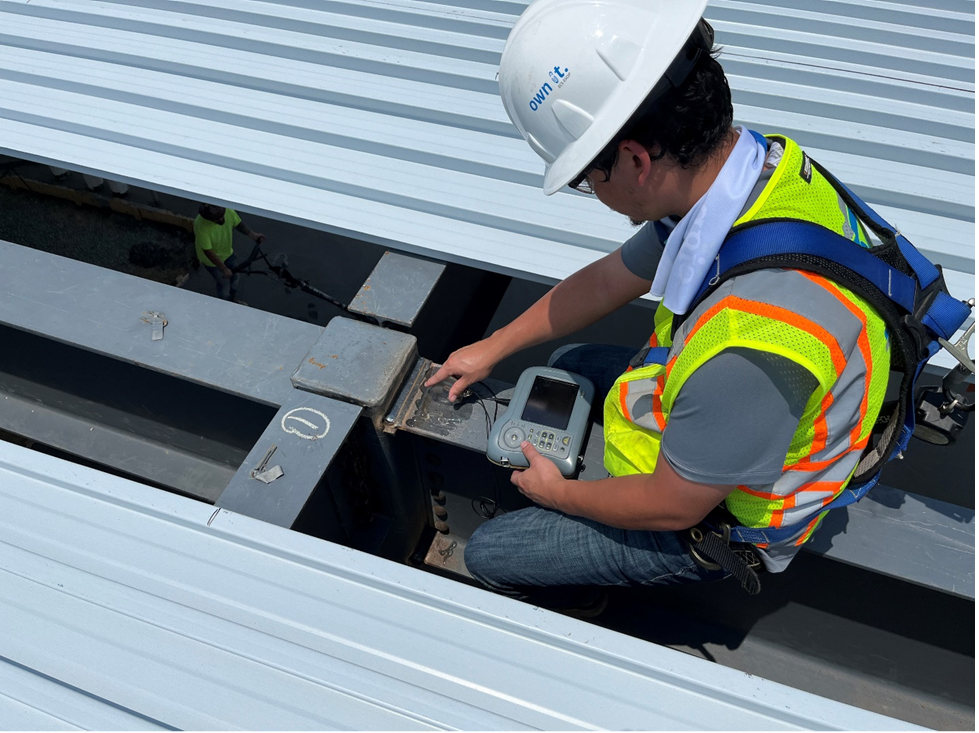
Structural steel demands visual and volumetric examinations to document weld quality and connection performance. ECS performs ultrasonic testing (UT) for moment and seismic connections per code and project documents. We combine visual testing (VT) for welds and bolt installation with ultrasound and other surface NDE methods to evaluate flaws, pinpoint crack initiation and confirm repairs in the shop or field.

nondestructive evaluation

Typical applications

  • Weld acceptance for complete joint penetration (CJP) moment connections
  • Process piping, pressure vessels, unpressurized storage tanks
  • Volumetric evaluation of CJP welds using UT and, where appropriate, radiographic evaluation; surface evaluation of welds using VT, liquid penetrant testing (PT), and magnetic particle testing (MT)
  • Verification after weld repair or modification

Methods we apply

  • VT: weld and bolt observation, remote visual for limited access
  • UT: contact straight-beam and shear-wave testing for weld evaluation, thickness measurement and corrosion assessment
  • PAUT (phased array ultrasonic testing): available for select projects, supported by specialized ECS teams
  • MT: portable yoke testing for surface indications in ferromagnetic materials
  • PT: visible and fluorescent dye on nonporous materials for surface breaking flaws
  • RT (radiographic testing): conventional radiography with Iridium (IR-192) and Selenium 75 (SE-75) for smaller, safer boundaries. Digital Radiography (DRT) and Real Time Radiography (RTR) set the pace for industry capabilities.

Why ECS for NDE Services?

Projects often require NDE to comply with building code and client specifications. Missing or incorrectly sequencing these steps can lead to rework, schedule impacts and liability. ECS solves this by integrating NDE with engineering, inspection and construction services—that means fewer vendors, faster coordination and recommendations backed by multidisciplinary expertise. Our certified level II technicians and certified welding inspectors (CWI) work alongside engineers to align the test plan with your schedule and compliance needs.


Construction materials

Structural steel demands visual and volumetric examinations to document weld quality and connection performance. ECS performs ultrasonic testing (UT) for moment and seismic connections per code and project documents. We combine visual testing (VT) for welds and bolt installation with ultrasound and other surface NDE methods to evaluate flaws, pinpoint crack initiation and confirm repairs in the shop or field.

nondestructive evaluation

Typical applications

  • Weld acceptance for complete joint penetration (CJP) moment connections
  • Process piping, pressure vessels, unpressurized storage tanks
  • Volumetric evaluation of CJP welds using UT and, where appropriate, radiographic evaluation; surface evaluation of welds using VT, liquid penetrant testing (PT), and magnetic particle testing (MT)
  • Verification after weld repair or modification

Methods we apply

  • VT: weld and bolt observation, remote visual for limited access
  • UT: contact straight-beam and shear-wave testing for weld evaluation, thickness measurement and corrosion assessment
  • PAUT (phased array ultrasonic testing): available for select projects, supported by specialized ECS teams
  • MT: portable yoke testing for surface indications in ferromagnetic materials
  • PT: visible and fluorescent dye on nonporous materials for surface breaking flaws
  • RT (radiographic testing): conventional radiography with Iridium (IR-192) and Selenium 75 (SE-75) for smaller, safer boundaries. Digital Radiography (DRT) and Real Time Radiography (RTR) set the pace for industry capabilities.

Facilities

Owners need rapid, low-disruption ways to assess roofs, building envelopes and concrete. ECS applies infrared thermography (IR) to identify moisture intrusion and insulation anomalies, ground penetrating radar (GPR) to map reinforcing steel and post‑tensioning prior to coring, ultrasonic testing to evaluate concrete and metal integrity, and LiDAR/photogrammetry to capture high‑resolution geometry supporting condition documentation and digital twins.

nondestructive evaluation

Typical applications

  • Roof moisture surveys to prioritize repairs
  • Concrete scanning to avoid cutting cables, conduit or rebar
  • Facade and bridge documentation for maintenance planning

Methods we apply

  • IR: roof and envelope scans
  • GPR: slab and wall mapping, coring clearance and pavement structure checks
  • LiDAR/photogrammetry: high fidelity models
  • Unmanned Aircr aft System (UAS) support: for less risky, more efficient data collection
  • UT (Ultrasonic Testing):
    • Concrete: pulse-velocity testing used to estimate relative concrete quality and correlate with compression strength testing
    • Metals: thickness testing and corrosion assessment
  • Radiography (film) and digital radiography (CR/DR): Radiographic evaluation for asset integrity and pipeline work is performed by ECS’ industrial NDE group. Current capabilities include film-based radiography using Iridium-192, with digital radiology (DR) planned. Radiographic servicers are applied where volumetric evaluation is required beyond the practical limits of ultrasonic testing.

Facilities

Owners need rapid, low-disruption ways to assess roofs, building envelopes and concrete. ECS applies infrared thermography (IR) to identify moisture intrusion and insulation anomalies, ground penetrating radar (GPR) to map reinforcing steel and post‑tensioning prior to coring, ultrasonic testing to evaluate concrete and metal integrity, and LiDAR/photogrammetry to capture high‑resolution geometry supporting condition documentation and digital twins.

nondestructive evaluation

Typical applications

  • Roof moisture surveys to prioritize repairs
  • Concrete scanning to avoid cutting cables, conduit or rebar
  • Facade and bridge documentation for maintenance planning

Methods we apply

  • IR: roof and envelope scans
  • GPR: slab and wall mapping, coring clearance and pavement structure checks
  • LiDAR/photogrammetry: high fidelity models
  • Unmanned Aircr aft System (UAS) support: for less risky, more efficient data collection
  • UT (Ultrasonic Testing):
    • Concrete: pulse-velocity testing used to estimate relative concrete quality and correlate with compression strength testing
    • Metals: thickness testing and corrosion assessment
  • Radiography (film) and digital radiography (CR/DR): Radiographic evaluation for asset integrity and pipeline work is performed by ECS’ industrial NDE group. Current capabilities include film-based radiography using Iridium-192, with digital radiology (DR) planned. Radiographic servicers are applied where volumetric evaluation is required beyond the practical limits of ultrasonic testing.

Environmental + geotechnical

For due diligence and remediation, ECS uses GPR to locate underground storage tanks (UST), utilities and buried structures—reducing excavation risk and cost uncertainty. Geotechnical teams benefit from GPR screening and LiDAR based terrain models for slope stability, drainage and access planning.

nondestructive evaluation

Typical applications

  • Environmental Site Assessment (ESA) support for UST confirmation
  • Utility clearance before intrusive work
  • Buried foundation and debris delineation
  • Predesign screening for anomalies
  • Slope and drainage assessments
  • Pavement and bridge condition studies

Methods we apply

  • GPR: subsurface mapping
  • LiDAR: terrain models for slope and drainage
  • Multichannel GPR (as available): highspeed, dense data sets for large areas

Environmental + geotechnical

For due diligence and remediation, ECS uses GPR to locate underground storage tanks (UST), utilities and buried structures—reducing excavation risk and cost uncertainty. Geotechnical teams benefit from GPR screening and LiDAR based terrain models for slope stability, drainage and access planning.

nondestructive evaluation

Typical applications

  • Environmental Site Assessment (ESA) support for UST confirmation
  • Utility clearance before intrusive work
  • Buried foundation and debris delineation
  • Predesign screening for anomalies
  • Slope and drainage assessments
  • Pavement and bridge condition studies

Methods we apply

  • GPR: subsurface mapping
  • LiDAR: terrain models for slope and drainage
  • Multichannel GPR (as available): highspeed, dense data sets for large areas
nondestructive evaluation

ECS delivers practical, code aware NDE that supports effective construction, smarter maintenance and confident decisions—without unnecessary disruption. Request a quote to discuss the right solution for your needs.

ECS delivers practical, code aware NDE that supports effective construction, smarter maintenance and confident decisions—without unnecessary disruption. Request a quote to discuss the right solution for your needs.