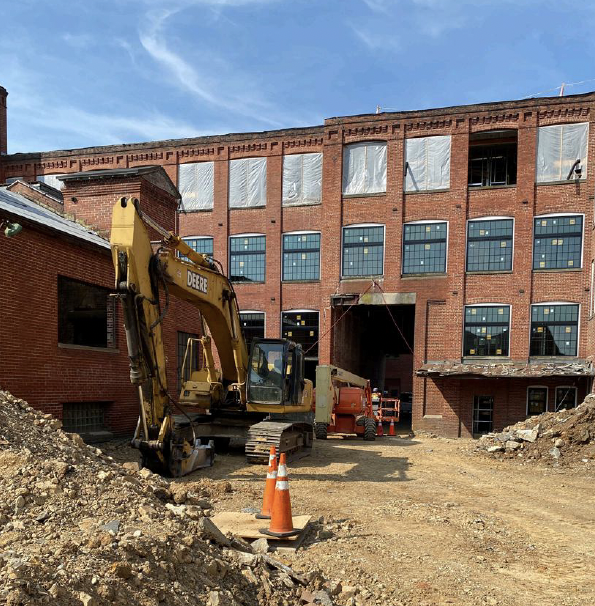
The Interwoven Mills redevelopment in Martinsburg, West Virginia, is transforming a historic textile mill into a vibrant mixed-use community. The ECS Group of Companies (ECS) managed environmental due diligence, site characterization and regulatory compliance across the 7.16-acre Brownfields property, once home to the Interwoven Hosiery Co.—the first electric-powered textile mill in the United States—which had stood largely unused since 1976.
Led by the Monument Companies, the $80 million project will deliver 370,000 square feet of redeveloped space, over 5,000 square feet of commercial use, and 387 market-rate residential units. ECS addressed challenges such as asbestos, lead-based paint, petroleum impacts and undocumented underground storage tanks to keep the project on schedule and budget. For its leadership during Phase I, the Monument Companies earned the 2025 WV Brownfield Economic Development Award.
How did ECS manage the environmental site assessments for Interwoven Mills?
ECS was engaged in early 2021 to perform a preliminary $110,000 site characterization that included:
- Phase I and Phase II Environmental Site Assessments (ESAs)
- Asbestos-Containing Material (ACM) Surveys
- Lead-Based Paint Surveys
This due diligence work provided a detailed understanding of environmental conditions and supported the site’s enrollment into the West Virginia Voluntary Remediation Program (VRP). ECS’ assessments supported the client’s long-term goal of sustainable redevelopment by providing data to forecast remediation costs, guide regulatory decisions, and assess redevelopment feasibility. The findings ultimately informed remediation specifications, supported financial planning and clarified the extent of regulatory involvement.
How did ECS overcome the environmental hazards identified onsite?

Managing decades of legacy contamination across multiple historic structures dating back to 1891 required strict adherence to WVDEP, EPA and OSHA standards. ECS addressed these challenges by:
- Enrolling the site into the WVDEP Voluntary Remediation Program (VRP) under the direction of a WV Licensed Remediation Specialist (LRS)
- Utilizing EPA-accredited asbestos inspectors and West Virginia–licensed lead inspectors
- Collecting and analyzing hundreds of samples using Positive Stop methodology and direct-read XRF spectrometry
- Implementing ASTM E1527-13, ASTM E1903-19 and WV Standard Operating Procedures for rigorous field quality control during Phase I and Phase II ESAs and all sampling activities
These efforts resulted in a code compliant and efficient assessment process that met applicable state and federal requirements.
What makes ECS’ approach to remediation management innovative?
The project stands out for its seamless integration of environmental due diligence with historic preservation. ECS supported one of West Virginia’s most ambitious Brownfields redevelopment efforts by providing the technical insight needed to revitalize an iconic industrial property in a way that balances safety, compliance and preservation.
ECS’ data-driven approach enabled cost-effective, sustainable decisions that will benefit future tenants and the broader community.

What were the outcomes of ECS’ environmental work?
ECS’ environmental assessments and regulatory coordination positioned the client to move forward confidently with planning and design for the redevelopment. The work also established a strong foundation for regulatory clearance and future construction phases.
Key lessons learned include:
- The importance of early and ongoing coordination among ECS, the developer and state regulators
- The need for comprehensive sampling and documentation for complex historic sites
- The value of adaptive investigative techniques that maintain safety, compliance and data integrity
- The benefits of anticipating regulatory shifts—such as proactively integrating PFAS considerations
How did ECS demonstrate its values?
- Collaborate: Partnered closely with Monument Companies and state agencies to align environmental work with redevelopment goals.
- Focus: Drove quality and compliance through ASTM, WVDEP and EPA standards supported by advanced field methods.
- Lead: Delivered proactive communication and regulatory guidance, helping transform an environmentally impaired site into a catalyst for community growth.